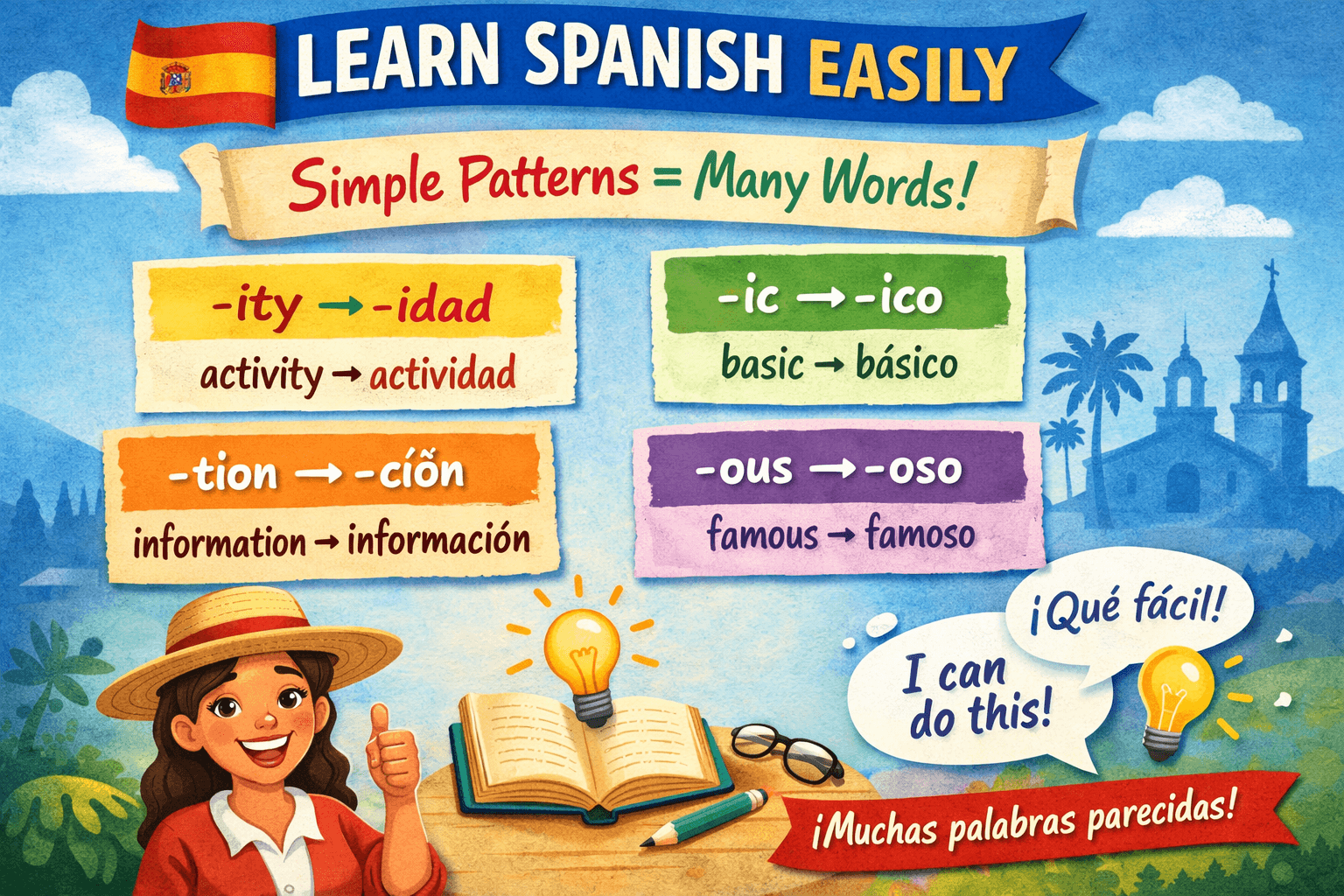
Easy Patterns in Spanish Help You Learn More Than You Think
One of the most common reasons people hesitate to learn Spanish is the feeling that it’s too hard — too many rules, too many verb endings, too much to remember.
But the good news is : you already know more Spanish than you realise.
English and Spanish share a huge number of words with common roots, which means there are simple, repeatable patterns that let you recognise — and even use — Spanish words almost instantly. You don’t need to memorise long vocabulary lists to start building confidence.
Below are some easy-to-learn patterns that can unlock dozens (sometimes hundreds) of Spanish words straight away.
(As with any language, there are exceptions — but these patterns work often enough to be genuinely useful.)
1. English words ending in “-ity” → Spanish “-idad”
This is one of the most reliable patterns.
If an English word ends in -ity, there’s a very good chance the Spanish equivalent ends in -idad.
Examples:
- activity → actividad
- community → comunidad
- possibility → posibilidad
- quality → calidad
- security → seguridad
Once you spot this pattern, entire categories of words suddenly feel familiar rather than foreign.
2. English words ending in “-ic” → Spanish “-ico / -ica”
Many adjectives follow this pattern.
Examples:
- basic → básico
- practical → práctico
- electric → eléctrico
- public → público
- automatic → automático
Spanish adjectives often change slightly depending on gender (-ico / -ica), but the core word remains instantly recognisable.
3. English words ending in “-tion” → Spanish “-ción”
Another very common and useful rule.
Examples:
- information → información
- situation → situación
- organisation → organización
- solution → solución
If you can recognise this pattern, written Spanish — notices, letters, emails — becomes much less intimidating.
4. English words ending in “-ous” → Spanish “-oso / -osa”
Many descriptive words follow this structure.
Examples:
- curious → curioso
- famous → famoso
- dangerous → peligroso
- nervous → nervioso
Again, the ending may change slightly, but the meaning is usually clear straight away.
5. English words ending in “-al” often stay very similar
Some words barely change at all.
Examples:
- normal → normal
- local → local
- general → general
- official → oficial
These are often the most encouraging words to spot when reading Spanish for the first time.
There are exceptions (but they shouldn’t stop you)
The point isn’t perfection. The point is confidence. When you realise how many Spanish words are already halfway familiar, the language stops feeling like a wall and starts feeling like a puzzle you can actually solve.
You don’t need flawless grammar to communicate. Recognising patterns, understanding context, and having the courage to try will take you much further than you think.
And every word you recognise is one less word to be afraid of.